image created by @literallyPR and used with permission
Welcome to the first stop on the blog tour for Little Gordon Grape, a Christian children’s storybook written by an author of faith.
This story was first written over 20 years ago by Arnold Dixon, who is a Methodist Minister, and the son of Windrush generation West Indian parents. It is now published in paperback as he feels that the time is right to bring his tale of hope to the current generation of children. It is simply written, to appeal to children in the early years and reflects the author’s firmly held Christian belief that even when events don’t seem to be going the way you wish, God is always there and you have a place and a purpose in life. In a few short pages of text Little Gordon Grape provides the allegory for a tale of ministry, an individual picked out from the depth of his misery, to spread a message of hope and love to those around him.
The book contains full page, watercolour illustrations, Gordon himself is portrayed with huge cartoonish eyes to appeal to a young audience.
This book is likely to appeal to Christian families, church schools and nurseries, Sunday Schools and the book boxes that many churches provide for families to borrow from during the service; it will be a welcome addition to their religious collection. It has clearly been written by someone with a sincere Christian faith, who wishes to spread the message of hope, faith and love to a wider audience.
I am grateful to Helen at LiterallyPR for providing me with a copy of Little Gordon Grape in exchange for an honest review and for inviting me to take part in this blog tour. Do check out the other blogs on the tour to learn more about the life-changing adventure of Little Gordon Grape.
Image created by @MarySimms72 and used with permission.
This is a weekly meme started and hosted by @marysimms72 on her brilliant Book Craic blog which I urge you to read. Also, please check out all the other posts and Tweets with the #MGTakesOnThursday tag, you will be sure to find many fantastic recommendations!
If you love books written for an MG audience and wish to take part, the steps to follow are:
Post a picture of a front cover of a middle-grade book which you have read and would recommend to others with details of the author, illustrator and publisher.
Open the book to page 11 and share your favourite sentence.
Write three words to describe the book
Either share why you would recommend this book, or link to your review.
Cover art by Luisa Uribe, published by Little Tiger Press
Author: Kurtis Scaletta
Illustrator: Cover image Luisa Uribe, internal images David Shephard
Publisher: Little Tiger Press
Favourite sentence from Page 11:
“Overall the show won eleven Tonys, including best musical.”
This book in three words: “Meet me inside”
I can give this book no higher recommendation than to tell you that as soon as it arrived through my letterbox it was read in one sitting by the teenage uber-Hamilfan in my household and given her seal of approval!
This latest biography from Little Tiger’s Trailblazers series is aimed at a Middle Grade readership with an engaging blend of illustrations, short chapters and fact-filled illustrated panels, but the evidence here suggests that it will also appeal to the huge number of Hamilton fans amongst the YA readership. Author Kurtis Scaletta presents the details of Lin-Manuel’s non-stop rise to the top of his profession in an engaging and entertaining manner. Throughout the book you learn about Lin-Manuel’s important influences, the stories behind his musical productions and his key collaborators as he has turned the world of musical theatre upside down. It certainly gives the impression of a man who writes as if he is running out of time and leaves you wondering “what comes next?”
As well as exploring Lin-Manuel’s unique musical and creative talent, this biography is careful to explain that a lifetime of hard work is behind the phenomenal success that he enjoys today. I also love that it outlines his continuing involvement with the Puerto Rican community, inspired by his father’s political work, and his determination to portray his culture in a positive light. His hugely generous charitable activities and his dedication to his family are further details which contribute to the picture of an individual who combines great talent with humility.
History certainly has its eyes on Lin-Manuel Miranda and this book fizzes with the energy apparent to anyone who has had the good fortune to see the live performance of Hamilton. I hope that it will inspire young readers to believe in their talents, follow their hearts and dedicate themselves to using their skills to make the world a better place. It is lovely to see a book which promotes the arts and their place in society as budgets for the arts seem to be constantly under threat both in schools and society as a whole. Highly recommended for all existing fans of Hamilton and all children who have an interest in music and drama.
I am very grateful to Little Tiger Press for providing me with a review copy in exchange for my honest opinion.
Published by Bloomsbury Children’s Books, 8th July 2021
I am thrilled to be joining Sophie Kirtley at the top of the East Lighthouse on Lathrin, for the blog tour for The Way to Impossible Island. From the moment I picked up this book, I was utterly captivated by the combination of characters, setting, theme and Sophie’s lyrical writing. Although I couldn’t finish it in one sitting – pesky chores; I wanted to! I predict that this is a book many children will lose themselves in during the school summer holiday. I love this book as an adult reader and can tell you that 10 year-old me would have been transfixed.
The themes of self-esteem and a child’s self-empowerment are seamlessly woven together with an immersion in the natural landscape. Oh, and there’s a time-slip adventure here too! If you loved Sophie’s previous MG novel, The Wild Way Home, you will enjoy revisiting some of the characters here. Research shows that both reading and an immersion in nature have positive benefits on mental wellbeing in adults and children. In my non-scientific study with a cohort of one subject, I conclude that the feel-good effects of this book are beyond doubt!
So as we gaze out over the island landscape, Sophie has very kindly agreed to answer some questions about the impact of the natural world on wellbeing.
Firstly, can I just thank you for allowing me to ask you some questions, based on your new MG novel The Way to Impossible Island, I’m grateful that you are taking the time for this, and I look forward to sharing your answers.
Thank you so much, Veronica, for having me on your blog and for all the support you give to books and authors (not just me!!) I think a lot of people can under-estimate the vital work children’s librarians do to matchmake books and young readers; so many children do struggle to make choices which fit their needs and tastes, so are reliant upon the expertise of others to help them make these choices. I love libraries and I’m delighted that initiatives like Cressida Cowell’s Life-Changing Libraries campaign seem to be gathering such momentum @CressidaCowellLife-Changing Libraries | BookTrust
As I am an ex-school librarian, now working in an NHS library, an area that particularly interests me is the effects of reading on mental health. I am struck by the sensory descriptions of the natural world in The Way to Impossible Island and would like to explore this with you.
That must be a fascinating change in direction for you. What an interesting setting!
To begin with, there is a tangible sense of place in the setting of the story, Lathrin Island. I suspect that it might be based on Rathlin Island, a place that I only heard about when I started a distance-learning course with the University of Ulster. Can you tell us whether Lathrin is based on an island that you have visited and your motivation for using it as the focus of the story?
Yes, you’re absolutely right – Lathrin Island is indeed based on Rathlin Island! I was born in Ballymoney, Northern Ireland and both The Wild Way Home and The Way to Impossible Island draw on settings which are warmly familiar to me from my own childhood. From an early age I was fascinated with Rathlin Island and I longed to go there, but even though we didn’t live that far away, for some reason we never did. It wasn’t until I was forty-two-and-a-half that I actually visited Rathlin for the first time! (see pic)
Sophie Kirtley on the way to Impossible Island, photo credit Andrew Kirtley
So perhaps that sense of longing and mystery which Dara gets from the island in the book is a bit like my own longing for that unreachable place! The more I researched Rathlin the more there was to draw upon for The Way to Impossible Island: the wildlife; the heritage; the myths.
I was a wee bit cheeky though as by calling it ‘Lathrin’ it gives me some licence to play around with the geography and not be utterly true to real life Rathlin. In real life, for example, Rathlin is the largest inhabited island off the coast of Ireland – there’s a whole community of people who live there; my ‘Lathrin’ island is only populated by cows and wild creatures! (see pic)
Rathlin Cows, photo credit James Logan
You include a variety of animals which impact key moments in the narrative for example the golden hare and the porpoises, have you always been a lover of nature and what is the appeal of the natural world to you?
Yes, wildness and the natural world are right at the heart of my books. It’s important to me not to just make animals seem cute or funny but to show how we all share a world together and ought to respect one another. Even when I was a girl I loved being outside – swimming in the sea, playing in the forest, running in the fields. The natural world felt, and still feels, boundless and unlimited; freeing somehow.
I am also intrigued by Mothgirl’s adoption of a wolf cub and utterly adored ByMySide’s character and narrative arc. Did you study wolves and their behaviour during the writing process, and could you tell us something about this?
Thank you. I love ByMySide too! Yes, I read a lot about wolves and wolf behaviour. Plus I was lucky enough to visit and observe an wolf pack at a conservation centre called the Wild Place Project in Bristol and to chat with, Zoe Greenhill, the specialist keeper there. Just watching these incredible animals and quizzing Zoe about their habits and behaviours really helped give me a deeper understanding which in turn helped me create ByMySide convincingly and respectfully too. @wild_placeWild Place Project – Home – Wild Place
Wild Place Wolf, photo credit Sophie Kirtley
Do you have any thoughts on the impact that taking care of a pet can have on children?
We have two cats, Dizzy and Dude, and my own children love them deeply. I think having a pet helps children learn empathy – they know when their pet is frightened or at ease and the deceptively simple act of reading the emotions of others and responding kindly is a hugely important life lesson.
Dizzy in a plant pot, photo credit Sophie Kirtley
It is not only your descriptions of wildlife that spoke to me, but there is also a particular passage quite near the end of the book when Mothgirl chases her wolf and the golden hare through a wheatfield and your description of the sights, sounds and smells was completely evocative of my walk to primary school, many, many years ago. How important do you think it is for children to be physically active outside and did you deliberately include these descriptions for children who might have only known city life?
I didn’t especially think of city children when writing these descriptions, but it’s really lovely to imagine my stories transporting readers to unfamiliar places, or as in your case, Veronica, to familiar places within their own memories.
I do think that time spent outdoors is very important for children’s (and adults’!) wellbeing and I’m delighted that the whole Forest School and Outdoor Learning movements seem to be gaining such momentum in the education world. I love reading about what educators like Mike Watson @WatsEd and Chartham Forest School @CharthamForest get up to on their wild adventures. I’m always especially thrilled when teachers get in touch with me to share the amazing learning beyond the classroom which has been inspired by my books; have a look on my website gallery page The Gallery – YOUR work | Sophie Kirtley to see the Stone Age settlements created by Leanne Moses’s class at Synchdyn Primary (@MosesLeanne@SychdynSchool) and the wild cooking around Langdale Primary’s campfire (@langdaleprimary).
I can only describe some passages in the story as poetic. Did you structure your writing this way to encourage some mindful reflection at these moments?
I’ve always written poetry, even before I turned my mind to fiction. So I think when my characters experience especially high or low moments in a story the poetry just pops out! I love being playful with structure and form in my writing, the passages which appear differently on the page are there to try to capture the extreme nature of the characters’ experiences in shape as well as in words. Sorry if I’m being a bit cryptic; I’m trying to avoid giving tooooo much away!
Both of your books, The Wild Way Home and The Way to Impossible Island seem to have the natural world and long-term environmental changes to a landscape as overarching themes. Did you consciously set out to bring these factors to the attention of your readers?
It’s funny because I didn’t consciously set out with this, or any, agenda – I just set out to tell an exciting and tender story. However, I find that as a story unfolds I’m often struck by how the themes I really care about do seem to come sneaking in at the edges. Appreciating and protecting the wildlife around us is something I care about deeply and never has there been a more essential moment to unlock conversations with children about the natural world and their role within it. Perhaps books are a way to spark these important conversations and open up the possibilities of change.
Several mental health charities for children, such as Place2Be and the Anna Freud Centre have encouraged young people to spend time in the fresh air to de-stress. Do you hope that reading about children adventuring in the natural world might encourage your readers to step away from their screen-based devices and spend some time connecting with nature?
I would never claim to be an expert in children’s mental health, but I do think there’s enormous power in connecting with the natural world – for children, for adults, for everyone – and perhaps reading adventurously, reading wildly, can go some of the way towards unlocking that power. Saying that, I do think there is value in screen-based activities too (building communities; learning collaborative skills; finding a sense of belonging) and I certainly don’t see time spent outdoors as a panacea. But, for me, I simply love being out in the natural world and I can definitely see why mental health charities are exploring these possibilities.
The chapter heading images throughout the story seemed to suggest the circularity of life, how reassuring do you think this aspect of nature might be for your readership?
A lot of what I write is about acceptance. In the Wild Way Home Charlie and Harby learn to accept that dreadful things can happen, but if we stick together and help each other then we’ll be OK. In The Way to Impossible Island Dara and Mothgirl have to each accept that they are different from the mould that their respective worlds have shaped for them and that they can celebrate themselves and each other for who they actually are. It was important for me to convey a message beyond a simple ‘happy ending’ – although my stories are fantastical in lots of ways they are grounded in our real world and I feel that in life it’s more helpful to accept than to seek to ‘fix’ things (like death or illness) which are difficult and inherently ‘unfixable’ and out of ourcontrol.
Thank you again Sophie. I was absolutely captivated by this book, and I am sure it is going to be hugely enjoyed by many, many readers; hopefully whilst sitting under the shade of a tree during the last few weeks of the summer term or the long summer holidays.
Thank you so much, Veronica. It’s been lovely to answer your interesting questions. I wish you best of luck with your job and with your University course. Have a lovely summer!
Sophie x
I am hugely grateful to Beatrice at Bloomsbury Children’s Books for my review copy of The Way to Impossible Island and for inviting me aboard the blog tour for this truly amazing book. Highly recommended for confident readers of 9+, for parents or carers to read aloud and share with children of 8/9+ and for Key Stage 2 classrooms who might be studying UK landscapes in their geography curriculum. Do stop at all the other blog posts on the tour!
Blog Tour image courtesy of Bloomsbury Children’s Books
The third of my reviews for this year’s #20BooksOfSummer challenge, hosted by Cathy at 746books.com is my only non-fiction choice this year and with my health librarian hat on, I would say that it is a book that everyone would benefit from reading.
Published by Michael Joseph Books, 2021
Dr Lucy Pollock is not just an experienced and compassionate geriatrician with a positive message to promote, she is also an engaging and entertaining writer. I was immediately struck by the accessible way in which she has presented a wealth of health information, which would be invaluable to a large percentage of the population, by framing this book through a series of stories with which readers can immediately empathise. The years of clinical experience are worn lightly and insights are presented with clear explanations which can be understood by anyone.
The Book About Getting Older celebrates longevity, explains how the final years of life can be lived positively and helps us all begin to have the necessary conversations about what is important to us as we get older. You will find clear-sighted and sensible discussion of poly-pharmacy, what is normal in old age and what is not normal, the concept of mental capacity, end-of-life care and a de-stigmatisation of dementia. Oh how I wish this book had been available 20 years ago when dementia cast its shadow in my own family. You see this book takes you by the hand as gently and kindly as the best clinician and leads you through so many aspects of the situations that confront us as we age, or watch those that we care for, age. In the company of Dr Lucy, the indignities and frailties of ageing do not seem such a frightening or lonely prospect. Quite the opposite, for the generous tone of this book is to celebrate the very old and to focus on those things that we can all do to live well for as long as possible.
It may also surprise you to know that there is a great deal of humour threaded through the book, with some passages that genuinely made me laugh out loud! The value of teamwork in the care of elderly patients is emphasised and practical ideas for improving social care are made, I hope that this book finds its way to the desks of some of our politicians! Dr Lucy’s respect for her patients as individuals and the life-lessons that she has learnt from them shine through the narrative. If people in power could see individuals through Dr Lucy’s lens rather than labelling older people with negative economic terminology such as “the demographic timebomb” one feels that something concrete would be done about social care.
I feel very passionately about this book, I think it will have a hugely positive impact on anyone who reads it and particularly for those who are in the lonely position of caring for a loved one. I have read the hardback version and also listened to the audiobook which is narrated by Lucy Pollock herself. In an ideal world everyone would have a geriatrician like Dr Lucy Pollock available when the complications of old age set in, the next best alternative is to get your hands on a copy of this book – in physical or audiobook format, and benefit from her wisdom, expertise and compassion.
Image created by Cathy at 746books.com and used with permission.
So, here it is; one summer, three months, 10 books and I’m three books in! Thank you Cathy for hosting!
Image created by @MarySimms72 and used with permission.
This is a weekly meme started and hosted by @marysimms72 on her brilliant Book Craic blog which I urge you to read. Also, please check out all the other posts and Tweets with the #MGTakesOnThursday tag, you will be sure to find many fantastic recommendations!
If you love books written for an MG audience and wish to take part, the steps to follow are:
Post a picture of a front cover of a middle-grade book which you have read and would recommend to others with details of the author, illustrator and publisher.
Open the book to page 11 and share your favourite sentence.
Write three words to describe the book
Either share why you would recommend this book, or link to your review.
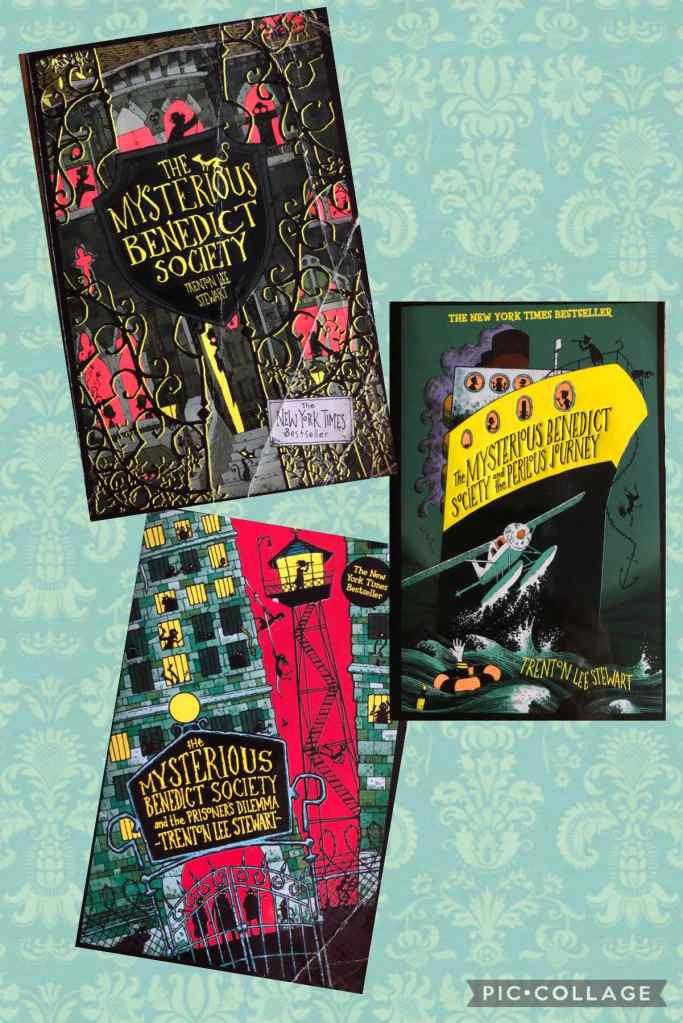
Cover art by Ross Collins, published by Chicken House Books
Author: Trenton Lee Stewart
Illustrators: Carson Ellis, Ross Collins, Diana Sudyka
Publisher: Chicken House Books
Favourite sentence from Page 11:
After a few more pages of questions, all of which Reynie felt confident he had answered correctly, he arrived at the test’s final question: ‘Are you brave?’
This book in three words: Complex – Mystery – Friendship
I was prompted to retrieve these books from the bookcase when I saw that The Mysterious Benedict Society had been released as a series on the Disney channel recently. I originally bought these three books about seven or eight years ago, based entirely on the name, with absolutely no reading of reviews or recommendations…and what a supreme piece of judgement!
I read them as bedtime stories to my youngest who was in Year 5 or 6 at the time, and a huge fan of MG Mystery/Spy books such as Ruby Redfort, The Sinclair Mysteries and the MMU series. We were both utterly hooked by the complex plotting, brilliant characterisation, and sense of foreboding combined with whimsy. You can probably tell from the battered covers that they have been re-read on more than one occasion! They centre around a team of four orphans who are recruited through a bank of tests, by the eponymous Mr Benedict, initially to infiltrate the Learning Institute for the Very Enlightened and uncover the identity of “the Sender”, a shadowy individual who is broadcasting subliminal disinformation and controlling the behaviour of the inhabitants of Stonetown through “The Emergency”. The plot seems strangely prescient in the light of the events of the past few years.
The four child protagonists , Reynie, Sticky, Constance and Kate, all possess extraordinary talents which they must find a way of combining in order to outwit their fearsome foe. One of the most enjoyable aspects of the first book is the interactive element of solving the coded problems alongside the team of undercover child spies. The magnificent writing draws you in to Reynie’s utterly loveable and quirky character from page one, and once hooked you are unlikely to want to do anything else until you have completed the third book. These stories are perfect for class read-alouds or bedtime stories, with their compelling, page-turning, plots and are fantastic independent reads for confident readers of 9+. I would highly recommend them to fans of Malamander,The Series of Unfortunate Events, Alex Rider or the books I mentioned earlier in the review.
The second of my #20(10)BooksOfSummer challenge is somewhat different from my usual reading material and was bought on the strength of my admiration for Hilary Robinson’s writing.
This gem of a monologue expresses the righteous indignation felt by a loyal servant, in defence of a master whom she feels has been unjustly portrayed by a biographer. The servant in question is Tabitha Aykroyd who devoted many years to the service of the Brontë family, after the Reverend Patrick Brontë lost his wife and was left to care for six young children.
Hilary Robinson has used her exquisite writing talent, and I presume her experience as a radio producer, to conjure a wonderfully nuanced portrait of family life at Howarth Parsonage through the authentic voice of Tabby. The perfectly executed monologue is written in six parts, entirely in Yorkshire dialect. Thanks to the inclusion of an explanation of the use of the > symbol to indicate a glottal stop and a glossary of Yorkshire dialect, I could hear Tabby’s voice in my head throughout, despite my southern origins! I really felt as if I was sitting at the kitchen table sharing a pot of Yorkshire tea with an old servant and hanging on her every word as she refuted the inaccuracies in Mrs Gaskell’s biography, The Life of Charlotte Brontë.
The tale is written as a repudiation of the negative impression that Mrs Gaskell gave, of the Reverend Brontë’s care for his offspring, in her publication. As a household employee of the family for many years, Tabby is incensed that her master’s reputation has been besmirched and her irritation is palpable as she sets the record straight. As her narrative unfolds, many biographical details of the Brontë’s lives and personalities, and the way that these informed their works of fiction, are revealed quite naturally; the author’s meticulous research manifests completely organically throughout. A tale of devoted family love and support, beset by constant tragedies, emerges in this short but moving monologue.
I adored this monologue and I would imagine that it will have huge appeal to those who love Charlotte, Emily and Anne’s writing. It is also likely to be a great companion piece to students who have to read one of the Brontë sisters’ novels for GCSE or A level. Furthermore, as one of the rare readers who is actually not a big fan of the Brontë’s novels, I thoroughly enjoyed immersing myself in this monologue and learning some of the background to a uniquely talented family. It is only available as an e-book at present, although I believe that an audiobook might be planned, which is excellent news for dyslexic readers. I actually listened to the excellent Audible reading of Jane Eyre by Juliet Stevenson in preparation for reading Old Tabby Brontë, the first time that I have managed to get to the end of that story, after three failed attempts to read it! I was certainly intrigued to learn about some of the experiences that influenced that classic novel.
This is my second post for this year’s #20BooksOfSummer challenge which is kindly hosted by Cathy Brown on her amazing 746Books.com blog. Do check out the other bloggers who are taking part in the challenge, it’s a great way to broaden your reading range.
I’m kicking off my #20BooksofSummer Challenge hosted by Cathy who writes the marvellous 746books.com blog, with a smart, entertaining and funny book aimed at the Middle Grade market: Mickey and the Trouble with Moles written by Anne Miller and illustrated by Becka Moor.
mc
I was delighted to discover that a second Mickey adventure, written with wit and whimsy by Anne Miller and wonderfully illustrated by Becka Moor, had been published last month as I adored the first in the series, Mickey and the Animal Spies. This book starts with a recap of the essential facts and can therefore be read as a standalone…although I would strongly urge you to read both!
Michaela Rose Thompson (Mickey) might appear to be an ordinary girl who dutifully attends school and gymnastics lessons and reliably takes responsibility for herself when her parents are working late on their scientific experiments. However, Mickey has an unusual aptitude for code-cracking and her undercover activities as human liaison officer to COBRA, a secret organisation of animal spies, set her apart from the crowd. This time she and her animal colleagues must delve into the rogue activities of the moles, dig into their motivation for tunnelling into the United Bank’s ‘Impossible Vault’ and try to unearth the brains behind the plan. Will Mickey’s obsession with the writings of Hildegarde L. McTavish help her crack the triple encryption and rescue a comrade before the ticking clock runs down?
If you like your spy mysteries to be filled with humour, quirky wordplay and an innovative use of seagulls as anti-surveillance accessories, this is the book for you! I would imagine that Anne Miller had enormous fun playing with the tropes of classic spy fiction to create this brilliantly amusing, engaging and satisfying story. It is the perfect length for newly confident readers to finish independently, has a great balance of whole and half-page illustrations by Becka Moor and as an added bonus contains an interactive element as readers are encouraged to crack different ciphers throughout the narrative. I enjoyed reading it enormously and know that it would have been devoured by my youngest had it been around when she was in primary school. As if things couldn’t get any better, it ends on a cliff-hanger, leaving this reader and I’m sure many others, hungry for book three!
This will be an excellent addition to classrooms, school libraries and home bookshelves for anyone of 8+, the blend of animals, spy mystery, humour and illustrations wrapped in a cracking plot making it one of those perfect books to read for pleasure.
I am very grateful to Liz Scott and Oxford Children’s Books for sending me a review copy in exchange for my honest opinion.
Image created by Cathy at 746books.com and used with permission
One summer, three months, 10 books! Thank you Cathy for hosting!
Image created by @MarySimms72 and used with permission.
This is a weekly meme started and hosted by @marysimms72 on her brilliant Book Craic blog which I urge you to read. Also, please check out all the other posts and Tweets with the #MGTakesOnThursday tag, you will be sure to find many fantastic recommendations!
If you love books written for an MG audience and wish to take part, the steps to follow are:
Post a picture of a front cover of a middle-grade book which you have read and would recommend to others with details of the author, illustrator and publisher.
Open the book to page 11 and share your favourite sentence.
Write three words to describe the book
Either share why you would recommend this book, or link to your review.
Author: Nicola Penfold
Illustrator: Kate Forrester
Publisher: Little Tiger Press
Favourite sentence from Page 11:
“It predates not only the floods and the Hunger Years, but the Decline, and even the Greedy Years before that. It’s from when the land was still healthy enough to farm, before the poisons and the saltwater got in.”
Cover art by Kate Forrester, to be published by Little Tiger on 8 July 2021
This book in three words: Environment – Family – Metamorphosis
This is an incredibly beautiful and powerful story set in a near future coastal community on the east coast of England. The extract that I have quoted from page 11, locates the reader in the space with great economy, as it describes Crier’s Windmill which will become a pivotal location in the story. As the book opens, you join Nat and his two best friends Tally and Lucas as they set off on their bicycles for summer holiday pranks and dares amongst the sterile landscape of the solar fields and Edible Uplands factory farm. It cleverly positions young readers in a recognisable activity before the clues about this dystopian future lead to the realisation of how society could be changed following ecological disaster.
Meanwhile, sisters Pearl and Clover, live with their father and their collective grief on an oyster farm; a ramshackle structure of narrowboats and the remnants of an offshore oil rig, held together as precariously as their family, with bindings that require constant re-knotting to stop the construction coming apart. We quickly learn that siblings are not allowed in the district of Blackwater Bay, where the feared Peacekeepers remove illegal second children, issue civil disobedience points and regularly send unlucky trespassers to the prison ship which is anchored further out in the bay. A visible reminder to all that resisting the state rule will be punished.
The two existences come together when Nat’s mum, Sora, a senior scientist, is sent by the District Controller to study the farming methods pioneered on the Oyster Farm to try to enhance food production for the district. When the “landlubbers” relocate to the feared world of the water, Nat brings some uninvited guests – jars of caterpillars that he has collected from the wild thistles in the solar fields. This act of rebellion (all pollinators are claimed by Central District) sets a metamorphosis in motion that will affect more than just the lepidoptera.
Nicola Penfold has written an exquisite story which brilliantly captures some of the pressing concerns of our age, she has crafted memorable characters and a plot that simmers with tension and edginess as the storm brews in the background. Her love of the natural world shines through the narrative which is peppered with a feast of Easter eggs in the form of the names of both human and non-human characters. She acknowledges the fact that children show far more awareness and concern about the environment and the plight of migrants than many adults; this is perfectly encapsulated by Pearl:
“You’re missing all of it because you’re not bothering to look! None of you are!”
I am sure that this book will prove to be extremely popular with upper Key Stage 2 and Key Stage 3 children, I can imagine it becoming a favourite whole class read, perhaps to accompany topics on global warming or food production. It is also a book that many adults would benefit from reading; a perfectly assembled plot with a thoughtful and valuable message. I loved it.
I am very grateful to Little Tiger Press and NetGalley for allowing me early access to an electronic version of this book which will be published on 8th July 2021.
Cover art by Sara Mulvanny, published by Little Tiger Press
If you want an MG story to grab you by your emotional lapels and hurl you back and forth like a trapeze artist’s swing, then buy your ticket to Cyrus Quinn’s circus, take your seat in the big top and enjoy the show!
From the opening line of the prologue I was absolutely enthralled as Ester defied her mother’s instructions and began her perilous journey upwards. As her dreams of flight segue into her son Bastjan’s story, I couldn’t tear myself away from his quest to investigate his mother’s past and return an ancient treasure to its rightful owner.
Sinéad O’Hart’s writing is lyrical, big-hearted and utterly compelling. She effortlessly brings Bastjan’s character to life on the page, the reader feels the warmth and love with which Crake, the circus strongman, provides protection and support for the young, orphaned tumbler. This is brilliantly contrasted with the cold tyranny with which Quinn treats his stepson as he tries to reverse the fortunes of his foundering business. Since the death of his star performer, Ester, who held the crowds enraptured with her Dance of the Snowflakes trapeze routine, the crowds have dwindled and Quinn will seemingly stop at nothing to replace her. But what was the secret of her aerial ability, and has her son inherited her fearless talent?
The arrival of an upper-class runaway, Alice Patten, proves the catalyst for twists and turns in the plot that build to a crescendo of explosive action. I will not go into any details for fear of ruining your enjoyment of a story with more thrills and spills than a tent full of acrobats. Suffice to say that the immaculate world-building combined with wonderfully drawn characters make this a book to be savoured, it is a hugely enjoyable work of speculative fiction combining a brilliant blend of circus, steampunk and fantasy. It will be massively enjoyed by confident readers of 9+ and would make an excellent whole class or bedtime story which I am sure that adults will enjoy as much as their young audience; just be prepared for constant pleas for “one more chapter”!
Skyborn will be published on 10th June 2021 and I am most grateful to Little Tiger Press for providing me with a pre-publication copy in exchange for my honest opinion.
Image created by Cathy at 746books.com and used with permission.
I’m hastily posting before the end of the month, that I am looking forward to again taking part in the #20BooksofSummer Challenge hosted by Cathy who writes the marvellous 746books.com blog.
Since moving jobs at the start of this year, I will no longer have a long summer holiday in which to read therefore I am going to set myself the modest target of 10 books this summer! I have to admit that after a long day spent mostly staring at a screen, there are some evenings when I just can’t face reading for an extended period, so I definitely cannot consume books as quickly as I used too. Looking back at my post from this time last year I notice that The Mirror and the Light is making a second appearance, which is a prime example of my lack of reading time over the past 12 months! I am hoping to re-discover my reading mojo and just as importantly I shall look forward to reading the reviews that other bloggers, taking part in this challenge, will post.
My list contains a mixture of MG and adult books, physical and e-books. One, Purple Hibiscus, is a re-read as it is this month’s choice for one of my book groups, and the solitary non-fiction title, The Book About Getting Older reflects my new job in an NHS library. Several of the MG books have been sent to me for review by publishers and one was a very kind gift from a blogger friend, Rachael, bellisdoesbooks.wordpress.com which I feel terribly guilty for still having in my TBR stack.
7 physical books from my TBR
3 e-books, 2 of which are book group choices
So, here it is; one summer, three months, 10 books! Thank you Cathy for hosting!




 V'sViewfromtheBookshelves