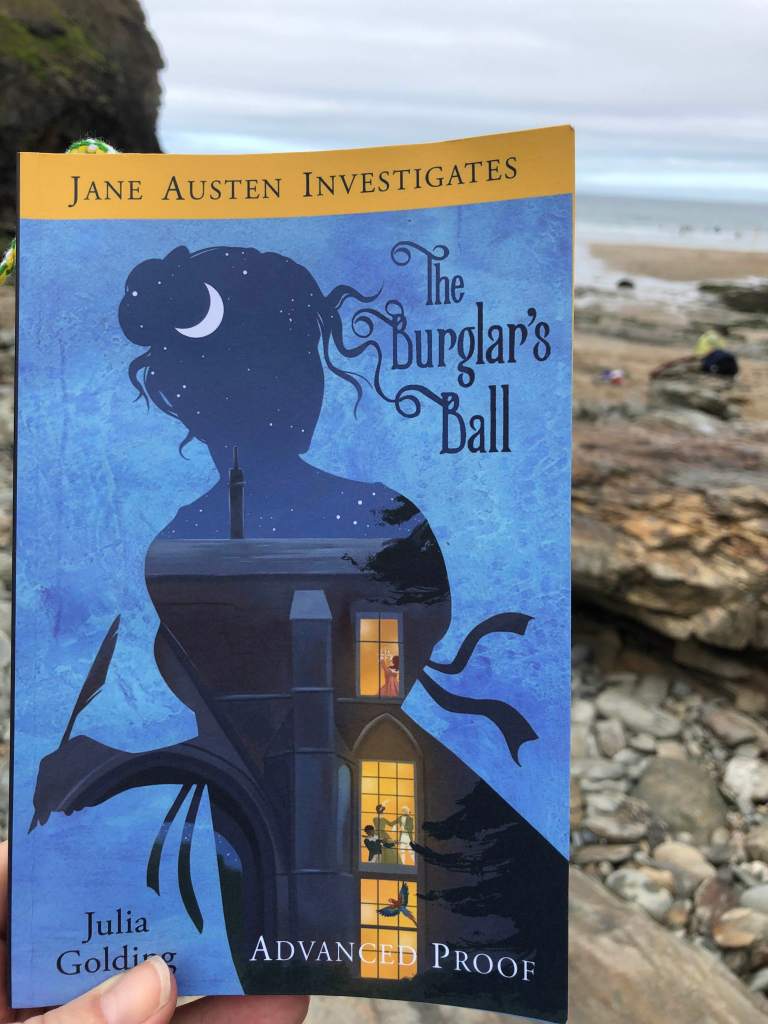
Review: Jane Austen Investigates The Burglar’s Ball, written by Julia Golding

Publishing on 22nd October 2021, Lion Hudson plc

The second book in the Jane Austen Investigates series, The Burglar’s Ball, is every bit as exciting and entertaining as the first, The Abbey Mystery. This is MG historical/detective fiction at its finest, an intelligent heroine, a mystery to solve, a cracking cast of memorable characters and a plot that will keep young readers intrigued.

Jane reluctantly accompanies her beautiful, older sister Cassandra to a Summer Ball at their old boarding school in Reading, a place filled with unhappy memories for Jane who was not a favoured pupil, unlike Cassandra. On arrival, it is apparent that Madame La Tournelle has organised the ball to rescue her school from its perilous financial position. She is doing whatever she can to attract new boarders from families who have the new-found wealth of The East India Company to pay for their daughters’ education. In preparation for the social occasion of the summer a dashingly handsome dance master, Mr Willoughby, has been hired and accompanying him is a freed slave, named Brandon who has natural musical talent. While Cassandra, the wealthy young Warren sisters and their orphaned cousin Lucy swoon over Willoughby, Jane is far more interested and compassionate about Brandon’s situation, and catching up with her friend Deepti who is now running a bakery in town with her father. Additionally, Jane’s sharp, inquisitive mind gets to work thinking about Madame’s lack of French vocabulary and the London accent that slips out when her guard is down! When a valuable diamond necklace is stolen on the night of the Ball it is up to Jane and her new friends to prove the innocence of an unjustly accused individual and discover the real culprit.

Julia Golding’s writing reflects that of the real Jane Austen in its perceptive examination of the social structure of the 18th century and particularly the role of females and wealth or lack of it, within society. She is also, with the privilege of hindsight, able to include some discussion of the exploitation of the people and resources of the colonised lands which generated much of the wealth enjoyed by those holding prominent positions. She does so through the eyes of the young Jane, so that this insight is provided as an integral part of the story and doesn’t slow the plot.

I am sure that The Burglar’s Ball will be a particular hit with readers of 9-14 who enjoyed The Abbey Mystery, and the historical detective and spy fiction written by Robin Stevens and Katherine Woodfine. Once again, there are cleverly constructed letters to decode and the narrative of characters from the first book are continued. The story also provides an enjoyable reading experience for those adults who might be reading aloud to children, or even for their own pleasure. If, like me, you are a massive Jane Austen devotee you will thoroughly enjoy the Easter eggs that author, Julia Golding, has scattered throughout the story; a knowledge of the original character names will certainly provide a head start in solving the mystery! This particular mystery draws on Sense and Sensibility for inspiration and one of the loveliest aspects for me was the portrayal of the sisterly bonds between Jane and her older sister Cassandra as well as Marianne and Elinor Warren, reflecting the narrative arcs of the Dashwoods in the original novel. Sharp-eyed readers will also spot plot points which reflect some of those in Pride and Prejudice. Overall, I rate this as a thoroughly enjoyable historical detective mystery, perfectly pitched at the upper KS2 and KS3 readership; a great read for pleasure in its own right and also a gentle introduction to the novels of Jane Austen.

I am most grateful to the publisher Lion Hudson for sending me a review copy, prior to publication on 22nd October 2021, in exchange for my honest opinion.

If you enjoy this book, why not try the Murder Most Unladylike series, the Sinclair’s Mystery series or the Ruby Redfort series.

For younger readers looking for a great introduction to spy and detective fiction, I recommend Mickey and the Trouble With Moles or Scoop Mclaren: Detective Editor.

The Fabulous Cakes of Zinnia Jakes: The Super Spy by Brenda Gurr, illustrated by Nancy Leschnikoff

Cover image by Nancy Leschnikoff, published by New Frontier Books UK

Regular readers of my blog will know how much value I place on books which give young readers the chance to become confident with their independent reading and at the same time discover the pure enjoyment to be found within the covers of a book. 

The Fabulous Cakes of Zinnia Jakes is a series of early chapter books, written by Brenda Gurr with lovely illustrated chapter headers created by Nancy Leschnikoff, perfect for children of 7-9 years-of-age. This third book in the series, The Super Spy is my favourite yet, the enticing cover image providing a perfect illustration of the combination of delights to be found inside.

For those unfamiliar with the series, Zoe Jones appears to be an ordinary nine-year old schoolgirl…but she harbours a secret identity, for she is in fact none other than legendary baker Zinnia Jakes! Helping her to conceal her undercover baking persona are Aunt Jam, with whom she lives when her father is away on overseas food critic duties, best friend Addie and magical cat Coco! (I have my own theory about Coco and wonder if Brenda Gurr will reveal more about this fabulous feline in future books).

Zoe and Addie along with all their classmates are hugely excited about the class sleepover in the school library:

They were going to sleep in the library, surrounded by hundreds of books and stories galore…Zoe was certain she would have sweet dreams that night!

Additionally, Zinnia Jakes has been tasked with baking one of her fabulous creations for the Parents’ Association spy-themed party which will be held in the school hall on the same night! As Zoe and Addie research the history of spying at the local museum and work on the cake design their own espionage skills lead to the discovery that there will be spy-traps to outwit if they are to continue their modus operandi of mysterious Zinnia Jakes’ deliveries!

This story packs many mouth-watering ingredients into its 100 pages. There is an exciting and fast-moving plot; an enjoyable sense of peril; a friendship based on thoughtfulness and kindness; a lovely exploration of research, planning and creativity; a celebration of museums; the best range of cooking-based metaphors and similes I’ve ever seen and the sprinkling of magic and humour supplied by Coco’s antics. What’s more, once you’ve enjoyed the story there is a recipe so that you can try baking your own Super Spy cake!

I absolutely recommend Zinnia Jakes The Superspy as an addition to home and school bookshelves for independent readers of 7-9 and think that it would also work well as a class or group read, perhaps linked to a DT or cooking project. Publisher New Frontier has provided teacher notes which include the hidden picture cake recipe on this link. Check out the other books in the Zinnia Jakes series too; you can read my review of The Fabulous Cakes of Zinnia Jakes Book 1 here.

I am most grateful to New Frontier Publishing UK for sending me a copy of this book in return for an honest review.

Midnight Magic – Mirror Mischief by Michelle Harrison, illustrated by Elissa Elwick

Cover image by Elissa Elwick, published by Little Tiger Press

Prepare for mischief and mayhem as a very special magical cat makes a second appearance on a bookshelf near you!

Midnight made her debut appearance in October 2020 and she leaps back into action just in time for this year’s Halloween celebrations. Once more Michelle Harrison has written a sparkling, delightful story in rhyming text which bounces along with an enchanting rhythm. Young readers will be captivated with the combination of short, easy to read, blocks of text interspersed with Elissa Elwick’s charming illustrations. It is so important for children who are just discovering independent reading to be presented with appealing, enticing books that invite them to read for enjoyment, and this book does exactly that with its endearing characters, hilarious story and short illustrated chapters.

Midnight’s sense of fun results in her conjuring up a “copycat” reflection of herself in the bathroom mirror, an impish doppelgänger who can cause all kinds of havoc in the reflected world without causing any trouble in the real world. It looks like a case of “mischief perfection” until the combination of excitable dog Doodle and enchanted broom Twiggy manage to send the mirror crashing to the floor! Once the copycat escapes into the real world there is nothing that Midnight, Trixie, Dad or Gran can do to stop the escalating chaos!

Young children will love the increasingly anarchic behaviour of the copycat and the extreme measures that Trixie and Midnight deploy as they try to catch the troublesome terror. In scenes which are reminiscent of children’s classic The Cat in the Hat, it appears that every part of Trixie’s home will be reduced to disorder! As for my favourite part of the book – it can only be the sight of Dad ironing the white school shirt at breakfast time; that’s true magic!

I highly recommend Mirror Mischief as an addition to your home and school bookshelves, it is a hugely enjoyable story for 6-9 year olds and would make a much better Halloween present than much of the orange plastic currently filling the supermarket shelves!

If you enjoy Mirror Mischief, do look out for the first Midnight Magic story too.

I am very grateful to Little Tiger Press for sending me a review copy of this book in return for my honest opinion.

Swop the Satsuma-Sized Secret by Lucy Noguera, illustrated by Laura Ireland

cover illustration by Fabio Gois, published by Brilliant Monsters Books

I absolutely love this gently humorous and endearing adventure written by debut author Lucy Noguera! It features a Key Stage 2 boy Ernie, who is facing some major upheavals in his young life. He is mourning the loss of his father and faces further change with a move from the countryside to London so that his mum can start working again as a doctor and the family can live closer to their gran. Whilst his mum and teenage sister Ivy are excited about the relocation, Ernie is having a much harder time adjusting.

Imagine his surprise and delight when he investigates the scuffling noises emerging from the battered leather suitcase that serves as his memory box, whilst he is unpacking in his new bedroom, and finds a tiny, satsuma-sized dog! Before his father’s death they had been planning to buy a puppy, so Ernie is understandably overjoyed with his pocket-sized companion. However, there are stresses involved too. The landlord has a strict “no pets” policy, and when Swop sneaks into Ernie’s lunchbox and accompanies him to school there are a multitude of embarrassing and awkward situations to be faced!

This book is special for a number of reasons. (At risk of sounding like Mrs Merton)…I was first attracted by its dyslexia-friendly format, clear font, off-white high-quality paper so that text does not confusingly bleed through and illustrations by Laura Ireland which give a young reader reflection time. As well as being accessible to children with dyslexic difficulties, the short chapters and fast paced plot make this an ideal book for newly emerging readers.

The story itself highlights many aspects of the need to ally with those individuals who might otherwise feel excluded, incorporated perfectly into the context of the story so that readers will not feel they are being preached at. Ernie’s teenage sister, Ivy, is deaf and communicates with sign language and lip reading. She is portrayed as a lively, outgoing character, always in the centre of things due to the necessity to clearly see people’s faces as they are speaking to her. This is such a positive example of an individual turning what might be seen as a disability into a positive factor in her life. Just as importantly, there are two characters in Ernie’s new class who demonstrate the kind, empathetic behaviour that all of us would like to encounter in our daily lives. Rafa, who befriends Ernie during his first calamitous lunch break and Clemmie who senses Ernie’s discomfort on his first day and positively intervenes to stop the unthinking sniggers of other classmates. Both are wonderful and age-appropriate examples of kindness for this story’s readership.

In case that all makes the book sound very “worthy” please be assured that it is also a humorous, entertaining and enjoyable story of a boy and his unbelievably cute dog. There are many laugh out loud moments as Swop causes chaos at school, some containing the delights of tiny dog accidents, which are guaranteed to appeal to the sense of humour of many young readers! I think that this story will be very popular for children of 6-9 years of age and I am certainly looking forward to the sequel which will be set at The Natural History Museum!

Lightning Falls by Amy Wilson, illustrated by Rachel Vale and Helen Crawford-White

Cover image by studiohelen.co.uk, published by Macmillan 19 August 2021

This was the Primary School Book Club choice for September 2021 and I am embarrassed to admit that, although I have been aware of Amy Wilson’s reputation for some time, this is actually the first of her books that I have read. Why did I wait so long? Her description of Lightning Falls or The Ghost House, as it is commonly known, had me hooked from the first page; in fact the house is so central to the story that it is a character in its own right!

Lightning Falls acquired its name from the extraordinary waterfall to which it is adjacent; a former grand manor house which is now a tourist destination for ghost hunters attracted by the “creaks and the squeaks” who often arrive clutching their “fifty-per-cent-off promotional vouchers from the Ghostwatchers’ Express”! Owned by Lord Rory, described as an adventurer, its only other human inhabitants are Mrs Peters the housekeeper, Leon the receptionist and Ted the chef. However, the main attractions are the ghosts of former ancestors of Lord Rory and deceased staff, who together make an extraordinary family for Valerie, the first-person narrator of the tale.

One of the main themes running through the story is Valerie’s search for her identity and origins, her solitary clue being the pendant that she was found with. She lives with the hollow feeling of always wondering who left her behind at the hotel as a toddler. She has been brought up to believe that she is a “hallowed ghost”, she exhibits many human characteristics alongside the abilities to remain invisible to humans and float alongside her ghostly best friend, Meg. The warm family relationships with which Valerie is supported by her ghostly and human companions are beautifully and believably written and greatly add to the enjoyment of this fantasy mystery.

As the story begins, Lightning Falls is being besieged by Star Storms which are having a serious impact on the hotel guests. Then a mysterious boy appears, sitting on the ruined viaduct which runs across the raging river, with threads of lightning appearing from his fingers. Valerie is determined to discover whether he is the cause of the storms, but when she confronts him she finds that he holds the keys to unlock her past.

I won’t give away any spoilers because I don’t want to ruin anyone’s enjoyment of this glittering and magical tale. Lightning Falls is a wonderful story for children of 9+ to add to their fantasy and Halloween reading lists and I appreciated the fact that it is not too scary; I know that 9-year-old me would have enjoyed this very much without the nightmares that accompanied some ghost stories! The themes of family taking many forms and the importance of valuing every individual for themselves independent of labels, appealed to me as I’m sure it will do many others in the light of conversations around allyship and inclusion. Finally, a big thank you to the Primary School Bookclub members who have opened my eyes to the magical writing of Amy Wilson, I now have another collection of books to add to my ever-growing TBR stack!

Lego Life Hacks by Julia March and Rosie Peet, models by Barney Main and Nate Dias

Published by DK Books, models by Barney Main and Nate Dias

Two of my great loves come together in this book: Lego and the publisher DK Books! I have bought many Lego DK books for my own children over the years and also have a large Lego collection built up over their childhoods, so when I saw this title available on NetGalley I immediately requested it.

I can confirm that it is marvellous, containing detailed written and photographic instructions for innovative Lego builds suitable for amateur to expert builders alike. There are 50 projects in total, but obviously you can then adapt these as far as your imagination will allow. Some examples include: a fun speaker to amplify your phone, a Lego houseplant, photo-frame or pen holder to decorate your desk, or a catapult to fling paper into the recycling bin! As a quick test I attempted a couple of the easier builds and you can see my efforts below. When I have more time I definitely want to try building the catapult which I think would provide some fun the next time the family are all gathered together!

My first builds: phone stand, cable holder and earphone cable tidy

It is always lovely to see children innovating with their Lego builds but sometimes imaginations need a little stimulation. The beauty of having this book in your home, classroom or library is that it provides that nudge to encourage readers to use their bricks in different ways and develop their creativity. This would make an excellent gift for keen young builders, or even those of us who might want to experiment with our children’s collections! In fact, there are many situations in which I could see this book being used including teambuilding or wellbeing sessions for adults and collaborative skills sessions for children. I loved the “Meet the Builders” touch at the end with profiles of the two talented individuals, Nate and Barney, who supplied the models for this book. The brick gallery is also incredibly useful for those of us who sometimes need to replace a missing brick from a model kit and have no idea where to begin the search; this could have saved me many hours in the past! In summary, I highly recommend this fabulous book as an addition to your non-fiction collections.

I am grateful to DK Books and NetGalley for allowing me access to an electronic version of Lego Life Hacks in exchange for an honest review.

#MGTakesOnThursday: The Week at World’s End by Emma Carroll

MG Takes on Thursday image created by @marysimms72, book cover illustration by Daniela Jaglenka Terrazzini

This is a weekly meme started and hosted by @marysimms72 on her brilliant Book Craic blog which I urge you to read. Also, please check out all the other posts and Tweets with the #MGTakesOnThursday tag, you will be sure to find many fantastic recommendations!

If you love books written for an MG audience and wish to take part, the steps to follow are:

  • Post a picture of a front cover of a middle-grade book which you have read and would recommend to others with details of the author, illustrator and publisher.
  • Open the book to page 11 and share your favourite sentence.
  • Write three words to describe the book
  • Either share why you would recommend this book, or link to your review.

Author: Emma Carroll

Illustrator: Daniela Jaglenka Terrazzini

Publisher: Faber & Faber Ltd

Favourite sentence from Page 11: 

When I told Ray what I’d found, I wasn’t sure he believed me.

page 11

This book in three words: Use Your Voice

The Queen of Historical Fiction swoops into the swinging 60s, plunging her devoted readers into the week during which the course of world history hung in the balance. 

Opening a new Emma Carroll novel is like a homecoming. You know what to expect: the domestic details of family life welcoming you in with a hot cup of tea, although when you step inside the furniture has been updated and someone you met as a twenty-something is now married with children.

Emma’s magic is to blend the domestic setting entirely seamlessly with her historic research so that you are utterly transported to whichever era she has mapped out for you. Her next sleight of hand is to take you inside the mind of a child so that you experience this new world firsthand and her writing is so expertly crafted that from page one until the final sentence you are utterly bound up in the adventure that unfolds before you.

I stood for a moment, enjoying how peaceful it was to not hear Bev yakking on, or the radio playing hit song after hit song because Mum, who hated silence, had barely switched it off since Dad died.

p3

Stephanie (Stevie or even Vie, to her closest friend) lives with her mother and older sister Beverley, at World’s End Close, a cul-de-sac backing onto wasteland adjacent to an American airbase. We learn early on that her father’s death occured very rapidly after the onset of an illness that wasted him away when he returned from military duties in an unnamed location exotic enough to give him an impressive suntan. To adults reading this story aloud it will be obvious what has happened to him, but Emma knows and respects her young readership and metaphorically takes their hand when revealing what has befallen him. 

Stevie’s next door neighbour and best friend is Ray, the son of an American airman and an English mother ( who Carrollistas will recognise from previous novels). Their friendship is built on their “otherness”, shunned by the other children at school, he because of his skin colour and Vie because she is so quiet, lacking in self-confidence and, in my interpretation, struggling with dyslexic difficulties.

Right from the opening pages, you are plunged into a world under threat from the Cuban missile crisis, with Ray’s family crowded round the television news listening to a speech given by their hero President Kennedy about the incoming threat from Russia and its communist ally Cuba.

Whilst Ray is captivated by this speech from his rock-star President, Vie becomes increasingly impatient as all she wants to do is drag him round to her woodshed to show him the “dead body” she has just discovered. When she finally gets him to accompany her, the dead body turns out to be a very much alive teenager who has “taken charge of her own destiny” and claims to be on the run from poisoners! With child-like trust, Vie and Ray do everything in their power to help Anna whilst the building tension of impending nuclear war envelops the adults around them in fear and dread. I am not going to describe any more of the plot details because I do not want to ruin your enjoyment of the brilliant unfolding and linking of plot. Instead I will concentrate on the things that make this book one that I enjoyed thoroughly.

The almost telepathic friendship between Vie and Ray, who can communicate with each other just with a nudge; they loyally support each other and extend their friendship to mysterious runaway Anna recognising a fellow outsider in need of help. The issues of nuclear weaponry are explored in a manner entirely appropriate for an upper end of middle grade readership. We see all sides of the argument as presented by different characters. Nana, their late father’s mum, initially supports the idea of all countries holding nuclear weapons as a deterrent, whilst Beverley signs up to the Campaign for Nuclear Disarmament and dumps her “mod” boyfriend when he tries to stop her from organising a protest march. Ray’s father works at the American airbase where nuclear weapons are stored but is presented as a loving family man, just trying to do his best for family and country. The mystery of runaway Anna and the poisoners from whom she is escaping is expertly woven into the narrative and is gradually unravelled to a hopeful conclusion. Finally the power of finding and using your voice to speak up for a cause you believe in, is effectively portrayed. 

The publication of The Week at World’s End was delayed by the pandemic, but ironically reading it in the light of the past eighteen months highlights many parallels of life being lived under threat from a fearsomely destructive force. The appreciation of the small joys in daily life that it can be so easy to take for granted will, I am sure, resonate with Emma Carroll’s legion of Middle Grade readers.

If you enjoy this book, then I highly recommend Emma’s previous novels, some of which I have reviewed in earlier blogposts:

The Ghost Garden

Strange Star

The Somerset Tsunami

When We Were Warriors

Secrets of a Sun King

Letters from the Lighthouse

Blog Tour: Kitty and the Starlight Song, written by Paula Harrison, illustrated by Jenny Løvlie

Published by Oxford University Press, artwork by Jenny Løvlie

I am delighted to be joining the blog tour for the eighth book in the delightful Kitty series. These beautifully crafted stories are so much loved by young readers that I’m honoured to be introducing you to the latest adventure of junior superhero Kitty.

For anyone who has not yet met her, Kitty is an ordinary primary school child by day, but when evening falls she dons her cape and mask and the cat-like superpowers that she has inherited from her mum allow her to scamper across the city’s rooftops with her feline friends, solving problems and righting wrongs. Kitty and the Starlight Song like the other books can be read as a standalone story, although it’s very unlikely that you’ll be able to resist reading more from the series once you’ve encountered Kitty on a moonlight adventure.

This story begins in the school hall, with Kitty and her class rehearsing for the school concert. In a scene which will be immediately relatable to young readers, Kitty is a bundle of nerves as her turn to sing a solo line of the song approaches. As the teacher plays her accompaniment, poor Kitty cannot find her voice and her cheeks grow hot as some of her classmates turn to stare at her silence. She returns home and shares her worries about her upcoming performance with her loyal cat Pumpkin, and resolves to practise hard over the next two days. However, her rehearsal plans are set aside when another of her feline friends Figaro is hurt as he tries to help Kitty apprehend a jewel thief. Kitty invests all of her energies in taking over the planning for Figaro’s birthday party to cheer him up and distract him from his mortification at having to wear a plastic collar! She rushes around the city gathering tasty treats, decorations and guests to create a perfect evening for her friend.

She pictured Figaro lying in the dark and feeling sad about his birthday. ‘I bet he isn’t asleep yet. Let’s get everything ready and then we can knock on the window! He’ll be so excited when he sees the decorations’

p83

Paula Harrison’s gentle storytelling is perfectly pitched for a readership in the 5-8 age range, although I have seen older children enjoying these stories too. She builds suspense and excitement but there is not so much peril that sleepless nights will ensue, indeed I would suggest that Kitty and the Starlight Song would make a lovely shared story at bedtime. Kitty and the Starlight Song is fully illustrated on every page in distinctive black, white, grey and orange by artist Jenny Løvlie. The gorgeous images, filled with detail, movement and personality complement the text perfectly and give young readers time to pause and reflect during independent reading. At just over 100 pages, Kitty and the Starlight Song is the perfect length to give newly confident readers the warm glow of satisfaction at reading a whole book alone and the design and size of the book is ideal for small hands.

If you know a Key Stage 1 or lower Key Stage 2 child who loves adventure, pets and problem solving, and you want to provide them with a story full of friendship, kindness, action and overcoming nervousness, look no further than Kitty and the Starlight Song.

My thanks to Liz Scott and Oxford University Press (Oxford Children’s) for providing me with a review copy and inviting me to join the blog tour. Do read the reviews from my fellow book bloggers throughout this week.

Cover art by Jenny Løvlie, published by OUP on 2nd September 2021

My reviews of earlier Kitty stories can be read here: Kitty and the Moonlight Rescue and Kitty and the Sky Garden Adventure

Review: Allies edited by Shakirah Bourne and Dana Alison Levy

Published by Dorling Kindersley 29 July 2021

This insightful collection of sixteen essays is an excellent resource for anyone who wishes to gain an understanding of the lives of individuals who might feel marginalised by their ethnicity, their religious beliefs, a disability or their sexual identity. It is pitched at a Young Adult readership but I think that the content is valuable for adults of any age. The goal of the book is to educate and enable the reader to use whatever privilege they might possess to become an ally to those who face challenges and perhaps discrimination, micro aggressions or outright bullying in their daily lives. 

I am embarrassed to admit that I had not really encountered the terms ally or micro aggression until I attended a disability workshop run by the well-known campaigner Samantha Renke earlier this year. It was listening to her daily, lived experience of the challenges that she faces negotiating a world that is not designed to enable her, that opened my eyes to the need for support or ally-ship from those of us who can encourage change. This book fulfills the same task, with contributions from authors who generously present their own experiences of either being made to feel marginalised or their attempts to fulfill the role of ally. It explains that micro-aggressions are the constant undermining comments that seem to diminish or dismiss an individual’s worth and that we cannot ignore these if we want to be an ally.

One of the aspects that I most appreciated is the tone of gentle encouragement, and forgiveness throughout. It can be very difficult to keep up with the evolving language around ethnicity or sexuality if you are not immersed in the study of it and several of the essays acknowledge that it is easy to inadvertently use the wrong words. The advice is to listen carefully to anyone who corrects you, apologise for any unintended offence caused by your words and continue to progress on your quest to be an ally. I found this to be very reassuring as I try and sometimes fail to get the language correct. In the opening essay, Dana’s Absolutely Perfect Fail-Safe No Mistakes Guaranteed Way to be an Ally, Dana Alison Levy states:

“Being a good ally without making mistakes is like eating popcorn without dropping any on the floor: it’s possible, but let’s be honest, it rarely happens.”

p.10

My takeaways from this book were that a mindset of openness, civility, empathy and kindness are required from us all to help every member of our society feel valued and that we can all learn from and support each other. I feel indebted to the sixteen authors who were prepared to open up about their experiences to help us all develop empathy and I really like the essay (and illustrated story) format that allows you to dip in and out and refresh your mind whenever necessary. At the end of the book there is a comprehensive list of further resources to explore, suggested by each of the contributors. I think that this will be a valuable resource for anyone who wishes to play their part in making society and their workplace kinder and more inclusive and I would recommend it to all workplace, academic and public libraries.

I am grateful to the publisher Dorling Kindersley and NetGalley for allowing me access to an electronic version of this book for review purposes.

Review: Secrets and Spies written by Anita Ganeri and illustrated by Luke Brookes

Cover art by Luke Brookes, published by Little Tiger Press

This colourful exploration of the undercover world of espionage is an exciting non-fiction book aimed at middle grade readers, published today by Little Tiger Press.

The artwork by Luke Brooks perfectly complements the subject, with its cinematic, comic book style. The cover image absolutely encapsulates the spy’s life in the shadows! The text by Anita Ganeri, a well-known author of children’s non-fiction is presented in small block paragraphs on the full colour pages in a very clear font, perfect for children’s to read and comprehend in small chunks.

The book begins with the early chapters covering the history of spying, dating right back to the ancient civilizations of China, Egypt and India. Prominent personalities in the history of spying are discussed. Some widely read children might have already heard of Sir Francis Walsingham, Queen Elizabeth I’s famous spymaster and will be interested to find out about the coding genius behind much of his success, a brilliant linguist called Thomas Phelippes. As the chronology progresses to World War II you will learn about prominent female spies such as Noor Inayat Khan (code-named Madeleine) the first female radio operator sent into occupied France and Violette Szabo who also carried out secret and dangerous missions in France. I think that children will appreciate the mixtures of styles, with purely factual pages sometimes giving way to imaginary newspaper stories reporting a case of the spy’s dark arts or the graphic novel-like biography of Harriet Tubman. I was particularly enthralled by the descriptions of different codes and ciphers as well as the modern cryptography on which we increasingly rely.

This comprehensive book will delight the most inquisitive child (as well as teens and adults) and could be used in so many curriculum activities (history, maths, geography, computing) that I would highly recommend it to primary school libraries and upper key stage 2 classrooms. I know from my own experience that a large number of primary school children are fans of MG spy fiction and I am sure that they would love to discover more about the world of covert operations and classified information. For children who love the adventures of Agent Zaiba, Mickey and the Animal Spies, Taylor & Rose Secret Agents, Ruby Redfort, The Mysterious Benedict Society or Alex Rider, this book is sure to be a mesmerising read.