#MGTakesOnThursday: Tilly and the Map of Stories by Anna James

Image created by @MarySimms72 and used with permission.

This is a weekly meme started and hosted by @marysimms72 on her brilliant Book Craic blog.

If you love books written for an MG audience and wish to take part, the steps to follow are:

  • Post a picture of a front cover of a middle-grade book which you have read and would recommend to others with details of the author, illustrator and publisher.
  • Open the book to page 11 and share your favourite sentence.
Cover image by Paola Escobar, published by Harper Collins Children’s Books
  • Write three words to describe the book
  • Either share why you would recommend this book, or link to your review.

Author: Anna James

Illustrator: Paola Escobar

Publisher: Harper Collins Children’s Books

Favourite sentence from Page 11: 

” I’m looking for a book.”

This book in three words: Magic – Imagination – Stories

A couple of weeks ago I used this meme to highlight my love for Tilly and the Bookwanderers, yesterday I finished reading an eARC of Tilly and the Map of Stories, due for publication on 17th September. It’s my favourite of the series so far, although it is going to cause me nightmares the next time I have to do some book-weeding in the library! Here is my review:

The third book in the Pages & Co series is a magnificent celebration of the magic of stories and an ode to the bookshops, libraries and imaginations from which they are dispensed. The love of story erupts from this novel and inflames your heart with a desire to revisit old favourites and examine their links to the newly published. Combining 21st century London tweens with a fantasy plot that includes encounters with the Great Library of Alexandria, the Library of Congress and a jaded William Shakespeare, this book takes you on an enchanted journey through literature!

Tilly and the Map of Stories begins exactly where book two, Tilly and the Lost Fairy Tales ended, with the scheming Underwood twins, Melville and Decima, continuing their dictatorial reign at the British Underlibrary; pursuing their own ends whilst deceiving their followers that they are working for the benefit of all. They have begun binding the source editions of books to prevent book wandering in them…but only a small minority of independent thinkers have the courage to question why. These dissenters of course include Archibald and Elizabeth Pages (Tilly’s grandparents), her mother Bea and a group of their close friends.

I have loved this series from the moment I began reading about Tilly and her grandparents’ bookshop Pages & Co in book one. The idea of being able to wander into the pages of favourite books and share afternoon tea with Lizzie Bennet enraptured me. The addition of librarian in-jokes about cardigans and the Dewey Decimal System just made it all the more engaging. Now with this installment, author Anna James takes us on a metaphysical adventure into the heart of Story itself, conjuring an immersive literary world in which Tilly and her best friend Oskar have to delve right to the origins of Story in their attempt to thwart the plans of the Underwoods. It opens with a customer in the bookshop finding himself unable to remember anything about the book which he intended to purchase and this grasping for memories of books is repeated with other characters. Relying on Tilly’s instinct that the curious assortment of objects she has gathered during her previous adventures are clues to the whereabouts of the legendary Archivists who guard the bookwandering world, her mother Bea despatches Tilly and Oskar to Washington DC to track them down.

I really do not want to go into too much description of the plot because it unfurls so perfectly that I cannot bear to ruin your enjoyment. The labyrinthine quest leads our heroes and thus the reader into the chain of stories where it seems only natural that after travelling on a train constructed of an eclectic mix of carriages, aptly named the Sesquipedalian, you might encounter Shakespeare arguing with Scott Fitzgerald!

Tilly and Oskar are two wonderful protagonists whose relationship has developed over the series to an acceptance of each other’s moods and almost telepathic understanding of each other’s reactions at crisis points in the narrative. Their friendship and partnership drives the narrative on as they seek the truth of the Underwoods’ abuse of book magic. As always, Tilly’s grandparents demonstrate steely determination to stand up against wrong-doing and in this novel Tilly’s mother Bea has snapped out of her dreamlike state and takes agency too.  The locations, real, historical and imaginary are brought splendidly into focus by Paola Escobar’s wondrous illustrations; I would love to spend many hours browsing Orlando’s bookstore Shakespeare’s Sisters situated in a former theatre! I also love the use of typography techniques to throw the reader off-balance at times in the story.

It is obvious that I adore Tilly and the Map of Stories and I think it is a book that many adults will relish reading to their own children or to a class of children. Confident readers of 10+ will love immersing themselves in the adventure on which Tilly and Oskar embark and hopefully will engage with some of the philosophical themes: the importance of imagination and collective memory, the need to share stories for the benefit of all and the necessity to question authority when it designs rules that only enhance the experience of a few.

I am most grateful to NetGalley and Harper Collins Children’s Books for allowing me access to an eARC in exchange for an honest review. I will certainly be purchasing a physical copy as soon as the book is published later this month as this is one of my MG highlights of the year so far.

Review: Question Everything! An Investigator’s Toolkit by Susan Martineau and Vicky Barker

Cover image by Vicky Barker, published by b small publishing

This slim, colourful volume is the perfect complement to information and digital literacy aspects of the primary school curriculum and I would highly recommend it to any teacher who is delivering digital literacy lessons as part of the computing curriculum as well as to every school librarian. 

With clear explanations in short blocks of text, written by Susan Martineau, accompanied by colourful images and diagrams, by Vicky Barker, it takes the reader through different aspects of negotiating the overwhelming quantity of information available through digital and printed sources. The digital-art-style images are perfectly in keeping with the content of this helpful guide to critical literacy.

There is advice on, amongst other things, how to extract the facts from text; how to look carefully at the use of language for signs of sensationalism or advertising; how to identify primary and secondary sources of information; how to spot whether something is fake news and how to avoid being misled by statistics. On each double page spread there is an incredibly useful Words to Know panel, defining key vocabulary for each subject at the point of reference. The activity included in each section could very readily be incorporated into information literacy sessions and I will certainly be aiming to use many of them to supplement existing lesson plans. At the end of the book there is some simple but effective online safety advice about avoiding online bullying, being brave enough to take breaks from the online world and keeping yourself and your online presence safe.

There are a multitude of uses for this brilliant book in schools. For those who have the budget I would suggest a set to be used in non-fiction, guided reading in Year 4 or 5 would be ideal. As previously mentioned, incorporating the ideas and engaging practical activities into digital and information literacy lessons, whether in classroom or library sessions, would be highly beneficial in helping young people to indeed Question Everything! 

The author Susan Martineau has written an interesting article on critical literacy and the background to writing this book for the CILIP Youth Libraries Group blog which you can read by clicking here.

I am most grateful to Toppsta and b small publishing for my copy of this book in exchange for an honest review.

Series Review: Clifftoppers written by Fleur Hitchcock

Cover image by Tom Clohosy Cole, published by Nosy Crow

I was very fortunate to win a set of the three Clifftoppers Adventures written by Fleur Hitchcock, in a Twitter giveaway, and thought I would take the opportunity to read them before placing them on the school library shelves.

What an absolute joy these books are, the epitome of pleasurable reads!

I can trace my own voracious reading habit back to my childhood “Blyton interregnum” (thank you Lucy Mangan for that magnificent description) and know how compelling child-centred adventures can be for an emerging reader. Fleur Hitchcock, a truly talented author, has created a series which serves up the delights of adult-free mystery solving in the beautiful British countryside. As I read these stories I could almost hear the cries of the seagulls and the rattling of the masts of the yachts in the harbour, smell the farmyard aromas and feel the sting of bonfire smoke in my eyes. They transported me back to carefree childhood summer holidays!

Each book is a self-contained adventure taking place while four cousins; brother and sister Ava and Josh, and only-children Aiden and Chloe get together at their grandparents’ farmhouse during the school holidays. Grandma Primrose and Grandpa Edward own Clifftopper Farm perched above Drake’s Bay, an idyllic getaway for their city-based grandchildren. Their farm dog Bella also plays a key role in the children’s adventures. The stories have a timeless feel to them and although the children are equipped with mobile phones, moorland and coastal locations seem to result in non-existent phone signals at key moments, which perfectly heightens the tension.

These books are just the right length for emerging independent readers to read for pleasure; the short, fast-paced chapters propel you through the story and provide a real sense of accomplishment as a young reader can complete one story in a relatively short time. Just make sure that you have the next one waiting for them on the bookshelf.

The Arrowhead Moor Adventure

Setting off on their first bike ride of the holiday, armed with a delicious picnic lunch (provided by Grandad, who refreshingly does all the cooking in this series) the children and Bella are almost run over by the impatient driver of a bright red sports car. Her aggressive manner immediately leads to suspicions in the children’s minds and when Aiden overhears her having a strange conversation with the owner of The Three Witches pub, followed by Chloe eavesdropping on a mysterious telephone conversation the children decide that the glamorous woman is up to no good.

Each of the four cousins has to call on reserves of determination and bravery as they pedal across moorland paths on the trail of jewel thieves and sheep rustlers, piecing together the clues to foil audacious crimes. 

With short chapters, often ending on cliff-hangers, this is a book which provides an excellent introduction to the detective adventure genre and will have young readers avidly seeking out the next book in the series.

The Fire Bay Adventure

As the story opens the children have just arrived at the farmhouse on the day before the annual Drake’s Bay Fire Festival, at which a huge bonfire is ignited on the beach by villagers carrying flaming tar barrels on their heads. Josh, the youngest and most demanding of the cousins is rather put out to discover that his eldest cousin Ava may take part in the barrel running whilst he is firmly banned from doing so!

The story cleverly combines ancient and modern smuggling plots, with a long-forgotten secret passage which has become part of the local lore making a surprise appearance, a spate of suspicious fires breaking out and dodgy deals in electronic goods being transacted at the harbour. Again the four tenacious children, aided by Bella and a terrified homeless cat, piece together the clues, give chase to the villains and show the bravery and teamwork required to bring the smugglers to justice.

The Thorn Island Adventure

This is my favourite of the series so far, partly down to the addition of a map at the front of the book – I do love to pore over a map!

Published during lockdown, this adventure will allow young readers to vicariously enjoy a thrilling coastal getaway, even if they have spent the summer holiday firmly rooted at home. With echoes of Swallows and Amazons, the eldest of the cousins, Ava, demonstrates her prowess as a sailor in this adventure as the four children try to track down a stolen fishing boat but find themselves investigating a kidnapping.

Whilst scanning the bay and the little offshore Thorn Island in search of the missing fishing craft both Chloe and Josh spot a mysterious face in a tower window. They manage to persuade Ava and Aiden that there may be a link to the newspaper reports of a child abducted from super-rich parents in London. Their daring rescue mission will have readers breathlessly following the twists and turns required to outrun a ruthless gang on land and on sea!

I do hope that there will be further additions to the Clifftoppers series as these are books which I can imagine 8-11 year olds devouring more quickly than Josh can demolish a plate of Grandad’s scones!

#MGTakesOnThursday: Death Sets Sail by Robin Stevens

Image created by @MarySimms72 and used with permission.

This is a weekly meme started and hosted by @marysimms72 on her brilliant Book Craic blog.

If you love books written for an MG audience and wish to take part, the steps to follow are:

  • Post a picture of a front cover of a middle-grade book which you have read and would recommend to others with details of the author, illustrator and publisher.
  • Open the book to page 11 and share your favourite sentence.
  • Write three words to describe the book
  • Either share why you would recommend this book, or link to your review.
Cover image by Nina Tara, published by Puffin Books

Author: Robin Stevens

Illustrator: Nina Tara

Publisher: Puffin/Penguin Books

Favourite sentence from Page 11: 

” All right,” said Daisy. “But – oh, if only something interesting would happen!”

This book in three words: Detective Society Forever!

It’s been a few weeks since I read and reviewed this perfect finale to the Murder Most Unladylike series and every time I spot it on the bookshelf I just want to pick it up again! I am still in awe at the way that Robin Stevens pulled all the threads together to complete the collection and I am so pleased that the book has become so successful.

To read my full review of Death Sets Sail, please click here – you will also find links to my reviews of all other books in the series.

Review: The Humans written by Jonny Marx illustrated by Charlie Davis

Cover illustration by Charlie Davis, published by Little Tiger Group

This is the type of non-fiction book that I would have loved as a child and still adore as an adult. With its large size and sumptuously coloured pages it invites you to open it out flat on a table or on the floor and lose yourself in the detail for as long as you can spare. It is certainly a book that I can imagine returning to on multiple occasions.

The book begins by chronicling the emergence of the genus Homo from apes and the eventual dominance of Homo sapiens over the other species such as Homo neanderthalensis and Homo erectus. There is then an excellent map showing the migration of Homo sapiens from the original ancestor Mitochondrial Eve’s birthplace in or near Ethiopia approximately 150,000 years ago. Then the continents are explored one at a time, with their main civilisations and the contributions that these humans made, presented in detail. A feature which I greatly appreciated was the “Where in the World” inset on most pages reinforcing the understanding that similar advancements were being made in different parts of the globe at similar times whilst also making you realise how geography contributed to certain developments.

Small blocks of text and large, bold headings are complemented perfectly by beautifully detailed artwork, enabling reading for information as well as for pleasure. This book covers many of the topics included in the primary school history curriculum as well as many that are not. In my opinion this is what is so special about “The Humans”, it covers many ancient civilisations that are not usually taught in schools and thus helps to put different historical periods into context, aiding the reader’s understanding of the global development of humans. To give one example of this, I was astounded to find a double-page spread on the Micronesians and Melanesians containing information on the design of their sailing vessels and the many languages and cultures found on the islands. I had not heard of the term “Micronesia” until I was an adult and I heard it in an episode of The West Wing! It delights me to know that primary school children will have the opportunity to learn about the emergence of this culture.

Finally, the civilisations are organised in a timeline, which again highlights just how much of human development occurred in periods which are not explicitly taught in the UK. My overall impression of this book is perfectly summarised in the final paragraph, humans are “an intelligent and resilient bunch. We are the best problem solvers on the planet.” This book does a wonderful job of presenting the awesome achievements of humankind and I highly recommend adding it to any school or home library.

I am very grateful to Little Tiger Group for sending me a copy of The Humans in exchange for an honest review.

#MGTakesOnThursday: Tilly and the Bookwanderers by Anna James

Image created by @MarySimms72 and used with permission.

This is a weekly meme started and hosted by @marysimms72 on her brilliant Book Craic blog.

If you love books written for an MG audience and wish to take part, the steps to follow are:

  • Post a picture of a front cover of a middle-grade book which you have read and would recommend to others with details of the author, illustrator and publisher.
  • Open the book to page 11 and share your favourite sentence.
  • Write three words to describe the book
  • Either share why you would recommend this book, or link to your review.
Cover image by Paola Escobar, published by Harper Collins Children’s Books.

Author: Anna James

Illustrator: Paola Escobar

Publisher: Harper Collins Children’s Books

Favourite sentence from Page 11: 

“Tilly had never been very far outside London, but she felt like a seasoned traveller within the pages of books: she had raced across the rooftops of Paris, learned to ride a broomstick and seen the Northern Lights from the deck of a ship. “

I just love the way that this quote encapsulates one of the joys of reading as well as referencing three of my favourite books published for children. It sets up the themes of this fantastic bookish adventure perfectly.

This book in three words: Books – Fantasy – Adventure

I am prompted to celebrate the first of the Pages & Co adventures by Anna James this week as I am overjoyed to have been approved for an eARC of the third book in the series, Tilly and the Map of Stories. For anyone immersed in the world of children’s literature this is a must-read; haven’t we all dreamt of being able to enter the world of our favourite books and speak to the characters who formed our early love of literature?

I think that Anna James’ writing is utterly wonderful and she absolutely captures the joy of becoming lost in a book, I highly recommend Tilly and the Bookwanderers to all confident readers, young and old, and encourage adults to read it aloud as a class reader or bedtime story to anyone of 9+.

My reviews of Tilly and the Bookwanderers and Tilly and the Lost Fairy Tales by Anna James can be read here.

Review: Trailblazers Stephen Hawking written by Alex Woolf

Cover image by Lisa Uribe, published by Little Tiger UK

This is the second biography from the Trailblazers series that I have been fortunate to read and once again it delivers on the series’ goal to inspire middle-grade readers with a story of a remarkable individual. Stephen Hawking’s life story is recounted by Alex Woolf in clear language, filled with everyday analogies which enable young readers to understand his revolutionary theories.

There is sufficient detail in this book to arm young scientists with an overall understanding of some of the key questions that cosmologists have tried to answer, and inspire them to formulate new questions of their own. If you will forgive the pun, the book starts with a brief history of the theory of black holes, presenting the key breakthroughs in understanding and naming the physicists and mathematicians involved. Alongside the chronological story of Stephen Hawking’s life this book is filled with information about new theories and discoveries in the fields of cosmology and theoretical physics. For example, the reader will learn that the term “black holes” was popularized in 1967 as the young Stephen Hawking was working as a post-doctoral researcher at Cambridge University.

Many fascinating details of Stephen Hawking’s life are included, I can imagine a multitude of young readers will identify with his childhood fascination with model trains and exploring The Science Museum in London. I was very surprised to read that he had not worked particularly hard for his undergraduate degree in Natural Sciences at Oxford, putting more emphasis on his rowing activities and socialising than on studying Physics! However, his diagnosis with the incurable disease amyotrophic lateral sclerosis (ALS) propelled him to focus his intelligence in a way that is inspiring to any reader.

The author Alex Woolf has addressed Stephen Hawking’s life challenges and scientific discoveries in language that confident readers at the upper end of primary school can understand, assisted by excellent diagrams and illustrations created by David Shepard. I would also recommend this book to any secondary school children studying GCSE Physics as excellent background reading to their syllabus. The use of panels throughout the narrative, summarising theories or describing key contributors to the understanding of the universe, certainly aide the comprehension of some complex scientific concepts.

Aside from its value as an educational science book, this biography presents Professor Hawking as an incredibly inspiring individual who refused to let his illness define him or hold him back from pursuing his intellectual dreams. The subtitle “A life beyond limits” encompasses his phenomenal cerebral achievements despite his physical restrictions and his 1983 theory of a “no-boundary” universe. His compulsion to ask questions, propose new theories and not be afraid of making mistakes is a great example to all of us. The fact that he became a best-selling author and cultural icon, even featuring in “The Simpsons” provides empowering knowledge for any young person who might be suffering with an illness or disability. At the end of the book one of his most famous quotes is printed, finishing with the words:

Be curious.

If all readers are inspired to follow this advice then who knows what new theories could emerge to solve the many unanswered questions that still exist about our universe.

I am most grateful to Little Tiger Publishing for my copy of this book in exchange for my honest opinion.

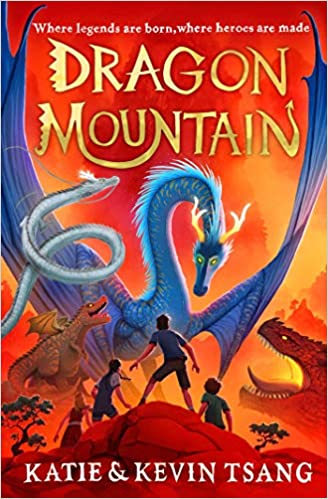
Review: Dragon Mountain by Katie and Kevin Tsang

Dragon Mountain Book Cover, published by Simon and Schuster Children’s UK

This first step into older MG fiction by the talented husband and wife team who write the hugely popular Sam Wu books is a thrilling adventure set in the mountainous landscape of China.

It opens with a teenage Californian surfing champion, Billy Chan, reluctantly arriving in China to attend a Mandarin culture and language summer camp. He finds that he is in the company of a group of talented teenagers who have all been nominated by their teachers or coaches to attend this unique camp and anxiety creeps in that his patchy Mandarin skills will leave him performing badly compared to the other kids. After a bone-rattling and stomach-churning drive up into the mountainous camp, Billy is pretty convinced that he would rather be back home surfing in the warm sea. However, he starts to form a bond with Irish lad, Dylan O’Donnell and is pleased that he is placed in the same cabin as him by the ancient Chinese camp leader Lao-Jin (Old Gold). On the first night, in the light of the campfire, Old Gold recounts the ancient myth of Dragon Mountain: the battle for supremacy between good and evil dragons and the source of the “River of Blood”.

The next morning the students are divided into teams of four. Billy and Dylan are placed together. Their additional team members are the outrageously confident Charlotte Bell, not just the holder of the Little Miss of the South title for four years, but also two-time ju-jitsu under-14 world champion, and the quiet, shy, dreamer Ling-Fei the adopted granddaughter of Old Gold. Each team of four is given a challenge to retrieve a specific item on the first morning and informed that the winning team will earn extra privileges throughout their time at camp. This is all the incentive that highly competitive Charlotte needs and she leaves her team in no doubt that they must win!

However, when they are confronted by a fierce tiger as well as an earthquake after taking a forbidden shortcut through a bamboo plantation, they find themselves caught up in a magical adventure that they could not have imagined.

The combination of contemporary teenagers bound up into a mythical fantasy is deftly handled, with the teens reacting in believable ways to the incredible scenario of bonding with dragons in a battle to save both the human and dragon realms from devastation caused by the evil dragon “The Great One” whose ambition is to rule over both kingdoms. This malicious dragon is aided by his followers, The Noxious or Nox-wings, an army of dark dragons.

Bravery, loyalty, strength and truth are the values in the hearts of the four teenage protagonists which have bound them to their dragons and alongside their dragon-bestowed powers, arm them for a battle with a fearsome enemy. 

I don’t want to give away any spoilers so I won’t go into any further details about the plot. This is a fast-paced fantasy adventure, likely to be devoured in a couple of days by confident upper key stage 2 readers; the plot grips you more tightly than a dragon’s claws. Equally it would be a great story for a teacher or librarian to read aloud…but be prepared for demands from the children for “one more chapter!” The book ends on an absolute cliff-hanger and I certainly hope I don’t have to wait too long to find out what happens next!

Highly recommended for fans of Harry Potter, Septimus Heap and  Percy Jackson.

I am most grateful to #NetGalley and Simon and Schuster Children’s Books for allowing me access to an e-ARC of Dragon Mountain. The book will be published on 3 September 2020.

The Key to Finding Jack by Ewa Jozefkowicz

Cover image by Katy Ridell, published by Head of Zeus

This is the second book that I have read by Ewa Jozefkowicz and I have to say that she has rapidly joined my list of favourite writers. This beautifully written and structured story within a story goes straight to the heart of identity, with its theme of unlocking the barriers that we put up to hide our true selves, even from those closest to us.

As regular readers of my blog will know, mystery novels are my genre of choice, and this contemporary tale of a twelve-year-old girl desperately seeking clues to unlock the location of her beloved elder brother had me hooked from page one. The story opens with Flick ( the narrator) trying to solve one of the complex puzzles that her older brother Jack habitually sets for her. The author has cleverly planted clues to the narrative within this opening puzzle, and this is just one of the details of Ewa Jozefowicz’s writing which I loved. 

Jack has just completed his A levels, in which he has astonished his parents by performing very well given their perception of him as a practical joker who has not applied himself to his studies in the way they would have wished. His father expects Jack to follow him into a career as a barrister and a law degree beckons once Jack returns from his gap year in South America. Flick is determined to treasure the remaining moments with Jack, realising that not only will she miss him while he travels, but she will see far less of him once he starts at university. Their relationship is cemented in the reader’s mind as one of love and mutual respect and encouragement.

Jack departs and Flick’s life continues as before, with her school days allowing us a glimpse of her hidden talent as a writer. Her class are set the task of writing a detective story and as Flick reads the opening of her composition aloud to her classmates you feel their incredulity at the quality of her historical story “The Case of the Beret and the Bell.” As she reaches the cliffhanger at which the young heroine Margot has disappeared in a huge London crowd she is summoned to the head teacher’s office to hear that Jack has been reported missing following an earthquake in Peru. The writing aches with the devastation and helplessness felt by Flick’s family. 

What follows is a tightly plotted and compelling unfolding of clues as Flick, assisted by her best friend Keira, seeks information about her brother’s location and in so doing uncovers the hidden details of his life. Starting from the key that he has always worn around his neck and which he has left in his room addressed to S.F., they track down all of his acquaintances who share those initials. At every turn Flick is able to unlock details of his personality from the heroic tales that each person recounts. In Flick’s words, “even the people you know well can be a cryptic puzzle.” In tandem with seeking her brother, Flick continues to write her historical story. The dual narratives of being true to your own desires and talents and having the courage to be honest about your identity in the face of the expectations of those closest to you are explored sensitively and movingly. Flick lives up to her brother’s childhood nickname for her, and Jack’s actions demonstrate that there is great importance in their grandmother’s elegant motto, “Don’t forget to live.”

In summary, this heartwarming tale of unfolding identity is equally enjoyable for adult and child readers of 9+. I read it as an eARC thanks to #NetGalley and Head of Zeus Publishing but I will definitely want to obtain a physical copy as soon as one is available. This book is due to be published on 3rd September 2020.

My review of Girl 38: Finding a Friend by the same author is here.

Review: Victoria Stitch Bad and Glittering by Harriet Muncaster

Cover illustration by Harriet Muncaster, published by OUP Children’s Books

Meet sparklingly wicked Victoria Stitch!

I predict that I will need more than one copy of this book when it is published in September; it is glorious in all respects and I’m sure will be in great demand. Harriet Muncaster’s brand of sumptuous illustration combined with brilliant storytelling is familiar to children who have enjoyed Isadora Moon as they became independent readers, and now as MG readers there is a darker, gothic story to enjoy!

Once you finish gazing adoringly at the cover art with its deep purple palette you fall into the realm of Wiskling Wood, home of the Wisklings; beautiful insect-sized creatures who hatch from gemstones in the Crystal Cave, possess antenna, dress with unique style and appear to display all the foibles of human behaviour! Only wisklings hatched from diamonds can ascend to the throne and this should have been Victoria’s and her twin-sister Celestine’s destiny. However, their diamond contained a flaw or “stitch” resulting in Lord Astrophel denying them the opportunity of growing up in Queen Cassiopeia’s palace. They have had to grow up together with only a series of state-appointed nannies to supervise them rather than being brought up in a loving family home.

This has built a supreme level of righteous indignation in Victoria Stitch, which she does not hesitate to display in outwardly hostile behaviour. Dressing like a princess, but all in black she insists on never leaving the tree house without her crown and petitions Lord Astrophel to be reinstated at the palace. Meanwhile Celestine accepts her destiny as a non-royal although she deeply regrets having been deprived of a loving family. She makes the most of what she has, gaining close friends and working towards her ambition of becoming a jeweller’s apprentice.

When Victoria flies off to the distant boundaries of “her kingdom” one day and meets the mysterious Ursuline she thinks that she has found a sympathetic friend; suddenly gaining access to the forbidden magic in the Book of Wiskling seems to provide the solution to her ambition and the plot takes off on a path which threatens to consume the last vestiges of sibling love. The dangers of accepting someone at face-value because they flatter you, without questioning their motives become very apparent!

I loved the complex world-building in this story; the wisklings’ homes in tree trunks; travelling on flying blooms and the society structured almost like a beehive were utterly compelling. The tension ratchets up with betrayals, suspicion and mystery which will have young readers gripped. Victoria Stitch is a fantastic new character and the reader is absolutely able to understand the motives for her demanding, diva-ish behaviour whilst recognising that her methods of achieving her dreams are less than ideal. Her twin appears to be in total contrast, the light to her dark, but as the story progresses you are given a glimpse into Celestine’s own inner turmoil. 

This is a delightful exploration of the bonds of love and loyalty, the importance of nurturing and fairness all wrapped up in a fast-paced MG mystery. The text is punctuated throughout with  beautifully intricate illustrations from multi-talented Harriet Muncaster which make the book an object of beauty and a joy to read for children of 9+ .

I am most grateful to OUP Children’s Books for sending me a proof copy of this book in return for an honest review.